
This entry comes from Valle O’Higgins, the town of 600 people nestled amongst the glaciers at the southern tip of the Carretera Austral, Patagonia’s 1,247-km “Southern Highway”. Although Valle O’Higgins is technically the end of the road, it’s still early days in my journey along the Carretera.
About a week into this bike trip, I decided to cycle the entire length of the Carretera Austral before continuing north through the country. But since there’s only one way to Valle O’Higgins (discounting the COVID-related headache of crossing into Argentina), I’ve had to come overland south… in order to return overland north again.
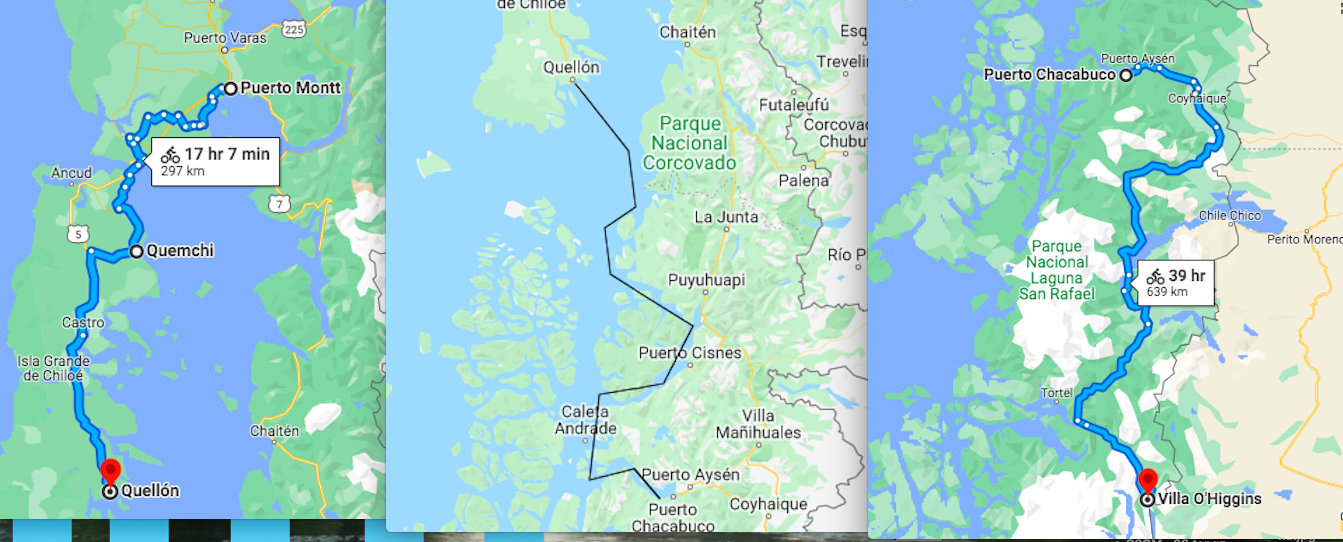


The Carretera Austral is beautiful. In the early 1970s, the Chilean dictatorship decided to build the highway to strengthen state presence in Aysén (northern Patagonia) and connect the sparse, isolated population to the rest of the country (at the time, the only ways to reach Aysén were by plane, or overland through neighbouring Argentina). So, in 1976, thousands of soldiers started carving a dirt road south from Puerto Montt through Aysén’s vast mountain ranges. By the late 1990s, the road finally reached Villa O’Higgins. Today, the northern half has been paved, but the southern part remains a treacherous gravel road.

My plan for tackling the Carretera Austral was to get south as fast as possible. After taking that 30-hour ferry from Quellon south to Puerto Chacabuco, I cycled 85km east to Coyhaique, the large town serving as the halfway point of the north-south Carretera. I enjoyed three nights in town with my host, Eliana, with whom I stashed my laptop and some over heavy items, before spending five days hitchhiking (about 340 km) and cycling (about 210km) to Valle O’Higgins. When I track back north, I’ll hitchhike the parts I’ve cycled and cycle the parts I’ve hitchhiked.

Bicycle travel along the Carretera Austral has been significantly more challenging than it was through Chiloe. The smooth pavement permanently turned into bumpy gravel just south of Coyhaique, and the distances between human settlements have stretched to about 100 km. The long uphill grinds through the mountain ranges are more difficult on loose, uneven surfaces, while the steep, bumpy descents demand intense focus. For cyclists, these snow-peaked mountains and turquoise lakes and rivers don’t come for free.
Riding the gravel roads with a fully-loaded bike has me thinking about shooting endless swifts (low-volume rapids) in a canoe. You’re constantly scanning ahead to read the road and pick the best line, routinely making adjustments as you go. Sometimes, however, there simply isn’t a good option – you can only grimace and curse as your bike rattles over the bumps.

Hitchhiking the Carretera is smooth enough, but demands lots of patience. The primary obstacle to rides is the lack of cars on the road. And, since I’m travelling with a fully-loaded bike, only a small percentage of those cars (pickup trucks and camper vans) are even able to help me out. But I’ve met met some kind and helpful people so far.
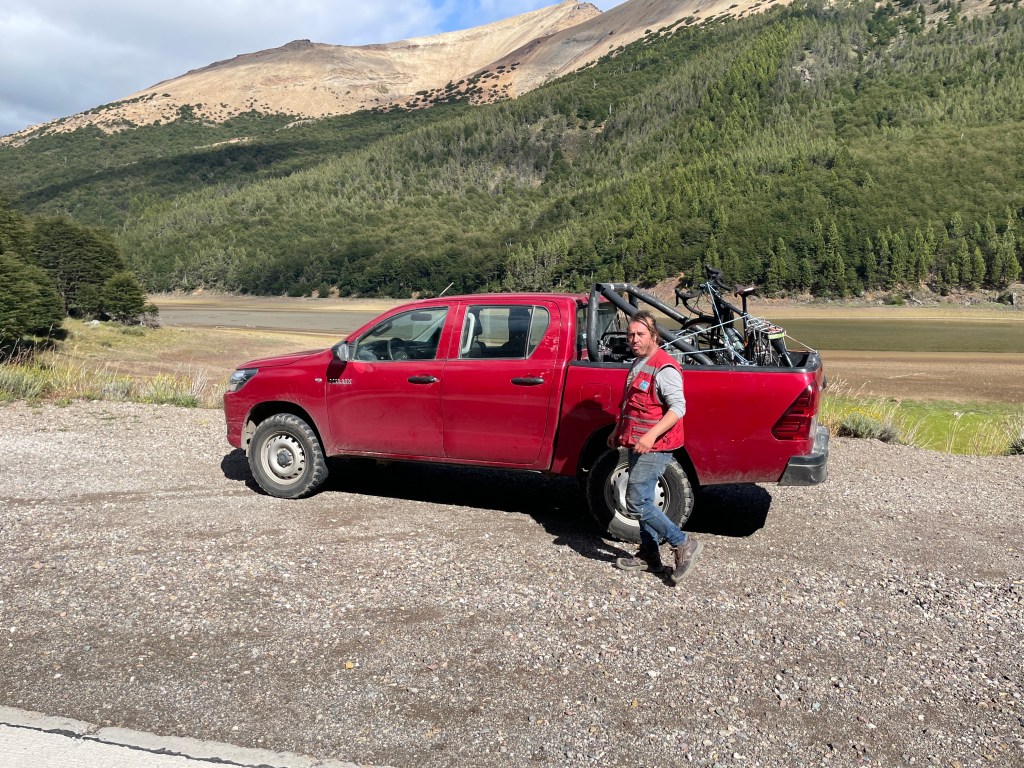
I got four rides on my way south, from Chilean workers, families, and tourists. The most memorable was Harry, a carpenter from Valparaiso who works 24-day shifts in Aysén before flying home for 10 days. He jumped out of his work truck, expertly secured my bike to the back, and proceeded to rip along the roads at an unimaginably fast pace. I had no choice but to grip the seat and trust his skills. Throughout the trip, Harry repeatedly reminded me that he would be the best rally car driver in the region.
It’s been nice relaxing for a couple of days in Valle O’Higgins. I’ve set up my tent at Hostería El Mosco, and have enjoyed the long-overdue shower, a great kitchen space, the stunning views, the nearby Lago O’Higgins and the company of fellow travellers. There are some motorcyclists, and few other bicycle tourists, some hikers, and two guys from Boise, Idaho, Nate and Will, who flew to Chile with their kayaks in October, bought a truck in Santiago, and have been paddling the southern rivers ever since.

The first part of the journey back north will be to hitchhike the 120km that took me almost a day and a half to cycle, before a quick side trip to Caleta Tortel. From there, it’s north all the way.


 Gilbert Coyle
This is wonderful. you may be having some rough roads, but I can’t watch the next game till February 6th. It rains on everybody. YNWA Cheers d
This all looks incredible. Smiling from cheek to cheek. Thank you for sharing pal!
Hey,
My wife and I are thinking of doing this route for our honeymoon in January 2023. We have done quite a bit of research on it but I am having trouble finding information on how we get ourselves and our bikes back to Santiago via Villa O’higgins? If you have any helpful hints on that and on this adventure please let me know.
Thanks a ton,
Ryan
Hi Ryan. That sounds like a great honeymoon. I had the same problem, that’s why I went down and back overland (hitchhike one way, cycle the other way). If you don’t want to do that, I suggest exploring three options:
1) Head north overland from O’Higgins (hitchhike?) to Balmaceda airport (just south of Coyhaique) and fly to Santiago from there.
2) If you have time, catch a ferry from Caleta Tortel (the other town at the bottom end of the Carretera) down to Puerto Natales, and then fly north from there.
3) See if the ferry route from Villa O’Higgins to Argentina are open (they were closed for most of COVID), and loop back up through Argentina.
Cheers,
Gilbert